



When a prop must meet a beam or a timber soffit rather than a flat floor, a plain plate top is the wrong end. The load needs to sit on the member, not slide off it, and the height needs fine adjustment that a basic nut cannot always give. That is the job of the U-head and screw top prop.
The U-head, a forked top plate, cradles a beam or stringer so the load stays axial and the member stays put. The screw top adds precise leveling for soffits and shutters. Together they turn a standard prop into a beam-ready support.
This article explains where U-head and screw top props earn their place, how they transfer load safely, and how to specify them for formwork and beam work.
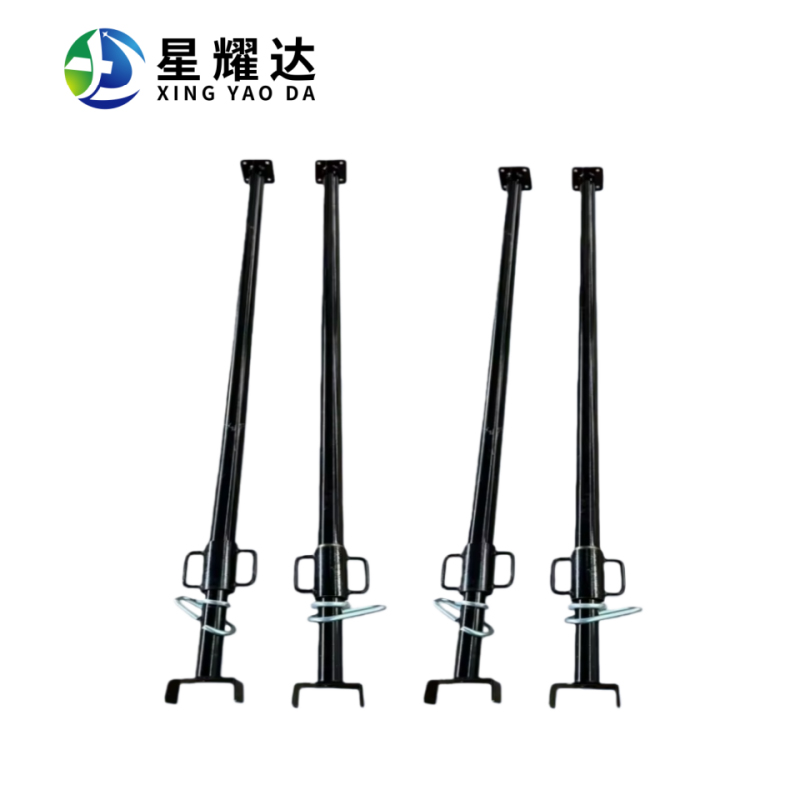
01. The Limits of a Flat Top Plate
A flat base or top plate spreads load on a level surface, which is ideal for floor-to-floor support. But against a beam or a timber soffit, a flat top lets the member roll or slip, introducing eccentricity the prop class does not cover.
Any time the support meets a line member rather than a plane, the top fitting should match the member. That is the design reason U-heads exist.
02. How the U-Head Works
The U-head is a forged or welded fork with a pin or ledge that cradles a beam, stringer, or timber soffit. The member sits in the fork, cannot roll sideways, and the prop load stays vertical through the beam.
Because the head is fixed to the prop top, the whole assembly adjusts as one unit. The beam is lifted, leveled, and held without separate packing that could shift under load.
03. The Screw Top Advantage
A screw top adds a fine-thread adjuster above the main nut, letting crews trim soffit level by millimeters without resetting the prop. For shutters and beams where fit matters, that precision saves rework.
The screw also keeps the load path continuous, the beam rests on the head, the head on the screw, the screw on the prop, with no loose packers to compress or eject under load.
04. Applications in Formwork
U-head props are standard under beam soffits and along slab stringers, holding the line members that carry the slab. Screw tops suit where the soffit must be leveled to a tight tolerance before the pour.
In refurbishment and fit-out, the adjustable head reaches awkward gaps and meets existing structure cleanly, which is why contractors keep a share of U-head props in every kit.
05. Tangible Fit and Safety Value
By cradling the beam, the U-head removes the slip and eccentricity that cause local failures and crooked soffits. The result is safer support and a straighter finished line with less packing waste.
For rental fleets, U-head and screw top props extend the kit's reach into beam and soffit work without a second product family, improving utilization.
06. Future Head Designs
Interchangeable heads, U, flat, and fork, on one prop body let crews swap the top to the task without changing the prop. Quick-release screw tops are speeding fine leveling on repeatable bays.
Galvanized heads are now standard for outdoor kits, keeping the thread free and the head inspectable through a long life.
07. Specification Tips
Match the head to the member: U-head for beams and stringers, flat for slabs, screw top where leveling tolerance is tight. Confirm the head is rated with the prop class at working height.
Keep the beam seated in the fork, torque the screw to the soffit, and inspect the head weld before each use. A sound prop with a damaged head is still a risk at the top.
FAQS
When do I need a U-head instead of a flat top?
Whenever the prop meets a beam, stringer, or timber soffit rather than a flat floor. The fork stops the member rolling and keeps the load axial through the beam.
What does a screw top add?
Fine millimeter-level adjustment of the soffit without resetting the prop, useful where fit tolerance matters. It also keeps a continuous load path with no loose packers.
Can a U-head prop carry the same load as a flat-top?
When the head is rated with the prop class at working height, yes. Always confirm the combined rating, because the head weld is part of the load path.
Are U-head props reusable across beam sizes?
The fork suits a range of beam widths; for very wide members check the fork span. The prop body and adjuster reuse normally across projects.
Do I still need packing with a screw top?
Usually not for leveling, the screw handles fine adjustment. Packing should be avoided in the load path because it can compress or shift; the head and screw replace it.
Should the head be galvanized?
For outdoor and repeated-use kits, yes. A galvanized head keeps the thread free and the weld inspectable, which matters for both safety and fleet life.
Conclusion
U-head and screw top steel props are the right end for any prop that meets a beam or soffit. By cradling the member and fine-tuning the level, they keep load axial, the line straight, and the support safe without loose packing.
Keep a share of U-head and screw top props in your kit for beam and formwork work, matched to your prop class. Our range pairs interchangeable heads with certified props, see our website for specifications.
References
European Committee for Standardization. EN 1065:1999 Adjustable Telescopic Steel Props. Brussels: CEN; 1999.
Concrete Society. Formwork: A Guide to Good Practice. 3rd ed. London: Concrete Society; 2018.
British Standards Institution. BS 5507:1986 Specification for Telescopic Steel Props. London: BSI; 1986.
Wang Lei
Technical Sales Engineer at Xingyaoda
Wang Lei is a Technical Sales Engineer covering steel support export markets. He helps distributors and project owners specify the right prop type, surface treatment, and standard (EN 1065 / OSHA / BS 5507) for residential, commercial, and infrastructure work, with 10 years in international construction supply.