



Steel supports get the attention in formwork specifications, but load rarely leaves a support through the tube alone. It exits through the bottom: a base plate or an adjustable base jack bearing onto whatever surface is beneath. That interface is where most formwork movement actually originates.
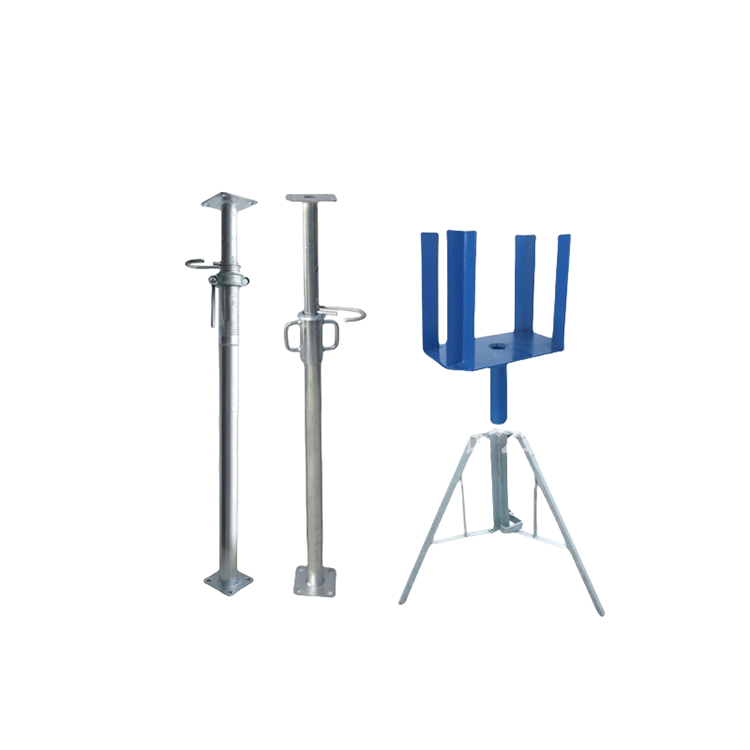
Bottom supports are also the cheapest items in the assembly, which is exactly why they are the most frequently under-specified. A jack that is too short, too loose in the tube, or bearing on a surface that settles will undermine a support that is, on its own, perfectly adequate.
The Load Path, From Slab to Ground
A concrete pour loads the formwork facing, which transfers to secondary beams, then primary beams, then into the head of the support, down the tube, and out through the bottom into the bearing surface. Every interface in that chain is a potential weak point, and the bottom is the one that is least visible once the deck is closed.
Treating the base as an accessory rather than a structural component is the root of most problems. A base sitting on a sloping surface, or a plate touching on one edge only, converts a compression load into an eccentric one, and eccentricity is how adequate supports fail.
What a Bottom Support Actually Does
A bottom support performs two jobs at once. It levels the assembly on ground or slab that is never perfectly flat, and it spreads the concentrated load from the tube into a bearing area the surface can accept. Both jobs matter, and they pull in opposite directions: more screw extension gives more levelling range but less stability.
The practical rule is to use the screw for levelling only and keep it close to its minimum extension. Significant height should come from a different support size, not from a jack wound out to its limit, because every millimetre of extension is unsupported length at the least stiff part of the assembly.
Plate Size, Thickness and Bearing Surface
Plate dimensions determine how load enters the supporting surface. A plate that is too small punches into timber, cracks a green slab, or sinks into compacted fill; a plate that is too thin dishes under load and loses full contact. Both conditions are invisible from above and both produce settlement.
The surface below deserves as much attention as the plate. Sound slabs are rarely a problem. Compacted fill, timber sleepers and recently poured concrete are, and the standard answer is a sole plate or timber bearer to spread load, plus confirmation that the surface will not settle under sustained load.
Thread Engagement and Nut Condition
The adjusting nut must be fully engaged on the thread, not hanging on the last few turns. Partial engagement is a common field shortcut when a few centimetres of extra height are needed, and it is one of the more reliable ways to produce a sudden drop during a pour.
Threads also need to run freely without excessive play. A thread that binds and then jumps under load will not hold position, and a support that settles mid-pour redistributes load to its neighbours in a way the design never assumed.
Checking the Bottom Before Every Pour
Bottom supports are easy to inspect and worth inspecting: nut fully engaged, screw within its working range, plate flat and fully bearing, weld at the plate-to-stem joint intact, and no sign of the unit having walked out of plumb since it was set.
Any jack with a bent stem, stripped thread or cracked weld should be withdrawn rather than straightened. These are inexpensive parts, and replacing one costs nothing compared with the rework that follows a settle-induced deflection.