



High-rise construction compresses every challenge of scaffolding into a vertical race: tighter schedules, heavier material loads, and the constant need to move crews and supplies up dozens of floors. Traditional tube-and-coupler systems can do the job, but the labor to tie every connection by hand becomes a bottleneck as the tower climbs.
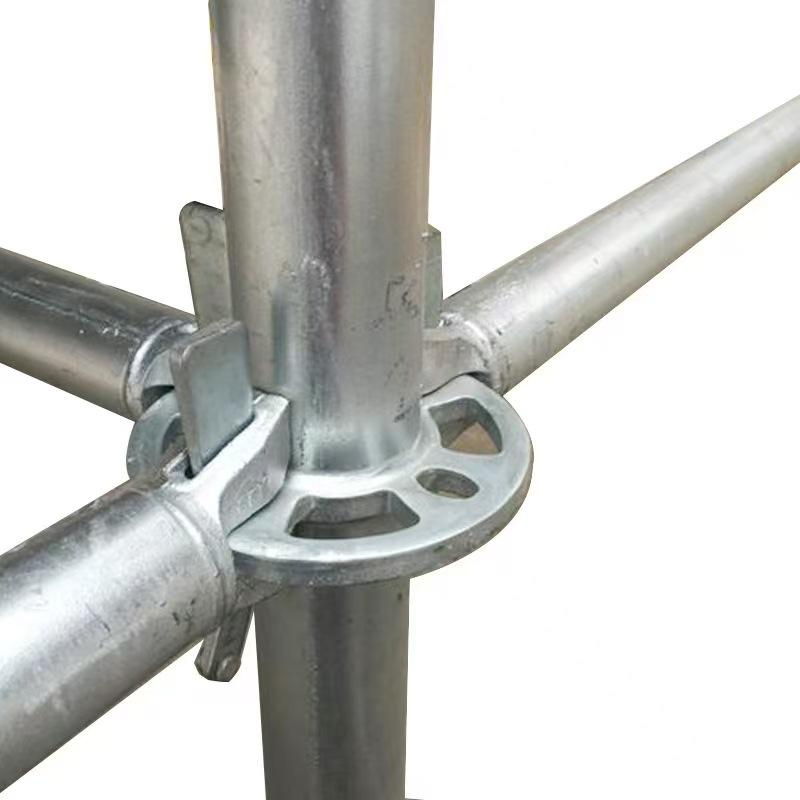
The ring lock scaffolding system answers this with a rosette node on each standard that accepts ledgers and braces through a single wedge lock. One hammer strike secures a connection that would take multiple couplers and several minutes the old way.
This article looks at how ring lock performs on tall buildings, where its load capacity comes from, and why contractors treating it as a system, not loose parts, see the biggest gains in speed and safety.
01. The Global Shift to Modular Scaffolding
Across Europe, the Middle East, and Asia, ring lock has become the default for commercial towers and industrial plants because it scales with the structure instead of fighting it. The same components build straight runs, birdcages, and façade access without custom fabrication.
For high-rise work the advantage is cumulative: every floor repeats the same bay geometry, so crews learn the pattern and accelerate. What took a day with couplers often takes half a shift with ring lock.
02. How the Rosette Connection Works
Each standard carries a cast or forged rosette plate with eight slots at 45-degree spacing. Ledgers and diagonal braces have a wedge-end blade that drops into a slot; a hammer tap closes the wedge and locks the member in place.
Because the connection is positive and visible from the ground, inspectors can confirm engagement at a glance. There are no loose nuts to over- or under-tighten, which removes a major source of human error in tube scaffolding.
03. Load Capacity That Matters on Tall Towers
Ring lock standards in 48.3 mm diameter with 3.2 mm wall thickness routinely carry platform loads of 3 to 6 kN/m2 for general use, and heavier for stored materials when bays are designed for it. Each rosette connection is rated for significant shear, so the system fails gradually, not suddenly.
The key is designing the bay size and bracing pattern for the load, not assuming the catalog maximum applies everywhere. Tall buildings with material hoists dumping loads at one point need localized heavy bays.
04. Applications Beyond the Facade
On high-rises, ring lock builds access scaffolds, loading bays, temporary edge protection, and shoring frames for slab formwork. Its flexibility lets one system serve structure, MEP, and cladding trades without switching product families.
In infrastructure, the same rosette geometry supports bridge soffit access and tank maintenance, which is why rental companies favor it: one kit covers building and industrial work.
05. Labor and Schedule Savings
Field data from commercial projects shows 40 to 60 percent lower assembly labor versus tube-and-coupler, mainly from fewer parts and faster locks. On a 30-floor tower that compounds into weeks of saved program time.
Faster striking also frees the kit for the next job sooner, improving fleet utilization. For a contractor, the system pays back through the schedule before the equipment is even depreciated.
06. Future Trends in Modular Systems
Galvanized-aluminum hybrids and lighter forged rosettes are cutting weight per bay while holding strength, easing manual handling on tall builds. Digital tagging of components lets rental firms track every standard's inspection history.
Prefabricated ring lock modules, delivered as pre-built frames, are shortening the critical path further on repeatable tower geometries.
07. Specification and Procurement Tips
Specify standard diameter, wall thickness, and rosette spacing up front, and confirm the galvanizing or powder coating suits your climate. Ask for load test reports per component, not just a general certificate.
Choose a supplier that stocks matching ledgers, braces, and decks so the system stays complete on site. A missing brace type forces improvised fixes that defeat the safety model.
FAQS
Is ring lock stronger than tube-and-coupler scaffolding?
In designed bays it carries comparable or higher loads with fewer connection points, and the wedge lock removes torque-dependent variability. The bigger gain is consistency: every connection is made the same way, reducing weak links.
Can ring lock be used for slab formwork support?
Yes. With appropriate bay sizing and heavy-duty standards, ring lock builds shoring towers (birdcages) under slabs. Many contractors use it for both access and shoring on the same project.
What galvanizing level do I need for outdoor high-rise use?
Hot-dip galvanizing is preferred for long-term outdoor exposure and coastal sites. Powder coating alone suits indoor or short projects. Match the finish to project duration and environment.
How fast is ring lock assembly really?
Crews typically report 40 to 60 percent less labor time than tube-and-coupler for the same scaffold, because each connection is one wedge instead of two couplers and several spins.
Do I need special training to erect ring lock?
Basic scaffold training covers it, but crews should learn the rosette orientation and brace patterns. The system is forgiving, yet proper bracing layout is still essential for stability.
Can I mix ring lock brands on one site?
Only if dimensions and rosette geometry match exactly. Mixing incompatible standards and ledgers creates unsafe gaps. Keep one compatible system per structure.
Conclusion
Ring lock scaffolding earns its place on high-rise builds through repeatable speed and a connection that inspectors can trust at a glance. Treated as an engineered system with the right bay design, it cuts labor while holding the loads towers demand.
If you are planning a tall build or an industrial plant, talk to our team about standard sizes, coatings, and load-rated layouts. Explore the full ring lock range and project references on our website.
References
Scaffold Industry Association. ANSI/SAIA A10.8-2019 Scaffolding Safety Requirements. Fairfax: SAIA; 2019.
National Access and Scaffolding Confederation. TG20:21 Tubular Scaffolding Good Practice Guide. London: NASC; 2021.
European Committee for Standardization. EN 12811-1:2003 Temporary Works Equipment - Performance Requirements. Brussels: CEN; 2003.
Li Ming
Formwork Systems Specialist at Xingyaoda
Li Ming is a Formwork Systems Specialist focusing on ring lock scaffolding and beam fixture applications. With 9 years in temporary works design, he has supported contractors on commercial towers, bridges, and industrial plants, helping them cut assembly labor while meeting OSHA and BS safety requirements.